





Written and reviewed by Francis M. Boyer | Board Certified in International Law by The Florida Bar since 2014 | Member, Hague Convention Attorney Network, administered by the US Department of State | Boyer Law Firm, Jacksonville, Florida. Published: August 2026 | Last verified against primary sources: August 21, 2026 | Next scheduled review: November 21, 2026
Summary: China and Russia are not Hague Child Support Convention party countries, and neither are Japan, Australia, or the United Arab Emirates. That closes the free treaty route. It does not close your case, because two other sets of arrangements exist, and a Florida court has reach the treaty has nothing to do with.
Key Takeaways:
- Five of the six most-searched countries are not parties. China, Russia, Japan, Australia, and the UAE are outside the 2007 Convention; Germany is inside it through the European Union.
- Three different lists get called the same thing. Convention parties, federal reciprocity arrangements, and your own state’s arrangements are separate, and a no on one is not a no on the others.
- A Florida court can establish an order with no treaty at all. Long-arm jurisdiction turns on where you and your child once lived, not on what the other country signed.
- If you live abroad, the door is open wider than you were told. Federal law lets the US state where the paying parent lives accept your application, and citizenship is not required.
- Getting an order and getting paid are two different fights. The second one turns on what the paying parent still owns inside the United States.
You searched the country’s name, found a treaty status table, and found no entry for it. Now you are holding a support order and an arrears figure that has not moved in months. A caseworker has told you there is nothing the agency can do.
That last part is not quite right.
Fifty-five countries and the European Union are bound by the 2007 child support treaty, according to the Hague Conference’s status table. The United States runs a second, shorter set of bilateral arrangements with countries that never joined it. A third set exists at the state level. Your country has to fail all three before the answer is really no.
Most people only ever check the first.
Is China a Party to the 2007 Hague Child Support Convention?
No. As of August 21, 2026, mainland China is not a contracting party, and there is no extension to Hong Kong or Macau. Russia is not a party either. Both answers come from the Hague Conference’s own status table.
A no there rules out one route of three.
What it means in practice is that your state child support agency cannot open a Convention case and send it abroad for you. The agency is describing its own toolkit accurately. Other tools sit outside it.
Which Countries Are Hague Child Support Convention Parties, and Which Are Not
Germany is a party. China, Russia, Japan, Australia, and the United Arab Emirates are not. Every line below was checked against that table on August 21, 2026.
| Country | 2007 Convention party | What it means for your case |
| China (incl. Hong Kong, Macau) | No | No Convention route. State reciprocity or a US court. |
| Russia | No | No Convention route. Same alternatives. |
| Japan | No | Outside the support treaty, but a 1980 Abduction Convention country. A Japanese order may still be registrable here. |
| Australia | No | Not a party, yet a US reciprocity partner since May 21, 2001. |
| United Arab Emirates | No | No Convention route and no bilateral arrangement. |
| Germany | Yes | Bound since August 1, 2014 via the EU; in force with the US since January 1, 2017. |
Japan causes the most confusion on this list. A country can be deep inside one Hague treaty and outside another, because the two do different jobs. The 1980 Convention decides which country’s courts hear a custody dispute after a child is taken, and it never decides custody itself. It has nothing to do with arrears.
Three Different Lists Get Called “a Country the US Has an Arrangement With”
Agencies, articles, and caseworkers use that phrase loosely. Three separate things sit underneath it, and which one you were told no about decides where to look next.
Hague Convention parties
The 2007 treaty gives you a free administrative route. Your state agency opens a case, and it moves government to government. That works only where the Convention is in force between the United States and that country.
Membership alone is not always enough. The federal child support office records that the United States objected to the accessions of Azerbaijan, Botswana and Guyana. No reciprocity exists with those three despite their treaty status.
Foreign reciprocating countries
These are bilateral arrangements made with countries that never joined the Convention. Australia has been one since May 21, 2001, Switzerland since September 30, 2004, and Israel since February 5, 2009.
Canada shows how fine the line runs. The Convention is in effect in British Columbia, Manitoba and Ontario. Alberta, Saskatchewan, Nova Scotia and six other provinces and territories are reciprocity jurisdictions instead, each declared in its own right.
Treat country lists on law firm sites with care. Several name Germany and France as US reciprocity partners. Neither has ever been declared one. The last federal declaration notice dates from 2014, and several countries on it have since moved to the Convention route.
Your own state’s arrangements
States negotiate directly with foreign countries, and those arrangements are the least known of the three. Two federal notes do not settle the question. Your state may already have said yes on its own.
What You Can Still Do When the Other Country Is Not a Hague Child Support Convention Party
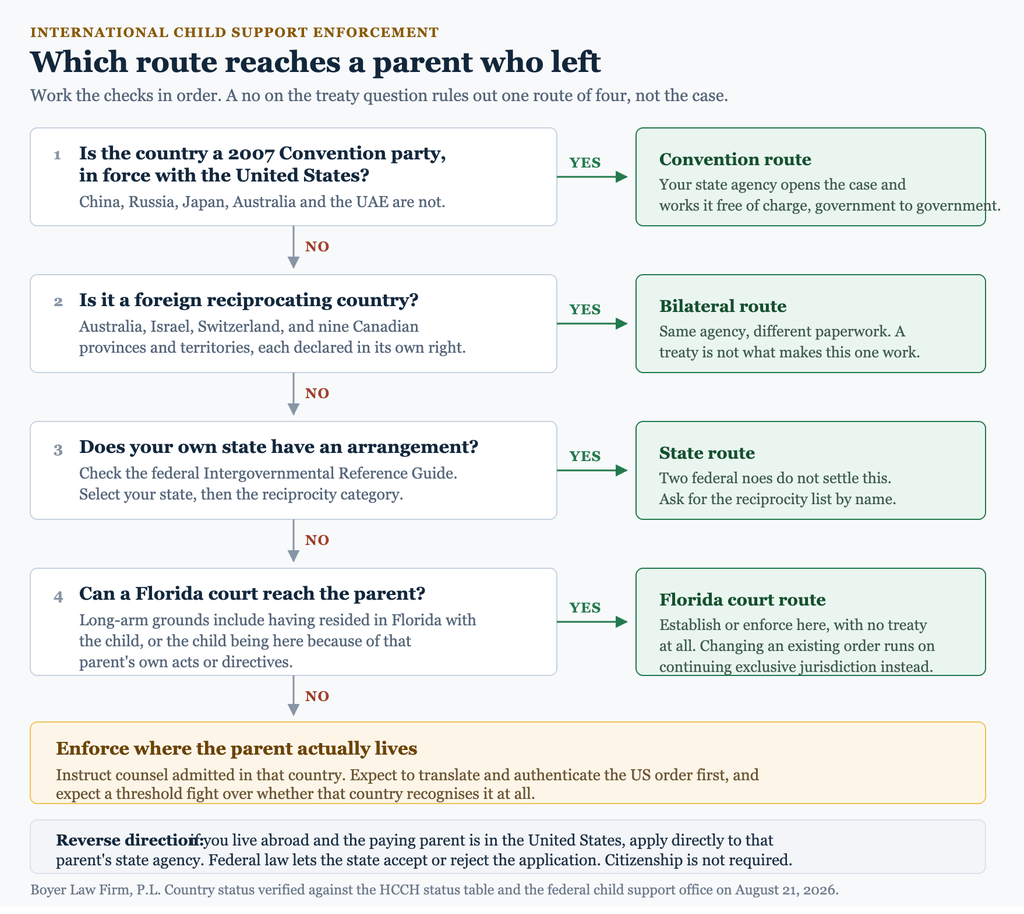
Three routes survive a treaty no. Your own state may hold an arrangement with that country even where the federal answer was no. A Florida court can act against the parent directly. Or enforce where that parent actually lives.
See the infographic below for the full decision tree.
1. Check your state’s own reciprocity list
The federal Intergovernmental Reference Guide holds a policy profile for every state, and each profile has a reciprocity section. Select your state, then that category, and read the countries it deals with directly. Caseworkers answer the federal question quickly and the state question rarely, so ask for it by name.
2. Use the Florida court’s reach over the parent who left
Florida’s long-arm provision lets a court establish a first support order against a parent now living abroad. Having resided in this state with the child is one basis. The child living here as a result of that parent’s own acts or directives is another. Six years in Jacksonville before a move to Shanghai is the strong version of the first.
The second basis is narrower than it reads. The Supreme Court set the limit in Kulko v. Superior Court, 436 U.S. 84 (1978). A parent who goes along with a child’s move has not purposefully availed himself of that state’s courts. Actual residence with the child is safer ground.
Changing an order already in place works differently. Florida keeps that power while this state remains the home of the paying parent, the receiving parent, or the child. It keeps it too where one party is in another state, and the other is outside the country. The long-arm provision alone never supplies it.
When Enforcing in the Other Country Is the Better Path
Where the paying parent’s income, home, and accounts all sit in the other country, a US order may be the slower route. Enforcing locally can be faster and cheaper with no treaty behind it.
That path involves counsel admitted in the destination country. A threshold question comes first: whether your US order will be recognized there at all. The judgment then needs translation and authentication under that country’s own rules before anything is filed.
In our practice, the forum question usually answers itself once we know where the paying parent’s assets sit. We check that first.
Boyer Law Firm works the US side and instructs counsel in the destination country. We do not appear in foreign courts. No US firm should tell you otherwise. Where the question runs the other way and a foreign order needs recognition here, that is Florida’s foreign judgment procedure.
Getting an Order and Getting Paid Are Two Different Fights
Most parents in this position can get an order. Collection is the harder half, and it turns on one question: what does the paying parent still own or earn inside the United States?
A US employer’s payroll, a US bank account, a tax refund, a Florida rental property. Each is something a court or an agency can reach, regardless of what the other country does. Where none of it exists, a US order still constrains what that parent can do here, even when no money moves.
One federal lever works regardless of location. Federal law requires certification of a parent who owes more than $2,500 in arrears, and the State Department then denies passport issuance and renewal. Its own manual is equally blunt about the limits. Posts abroad do not search for a parent who has stopped paying, and will not release location information to you.
Arrears keep accruing wherever you live, and a modification is not retroactive past the day you file. In Florida, past-due support also carries interest once the delinquency becomes a judgment. States differ sharply on this.
If You Live Abroad and the Paying Parent Is in the United States
Direction changes the mechanics, and this is where most articles have it backwards.
If you are in a Convention country, your own country’s central authority transmits the application, and a US state agency takes it from there.
If your country is not a Hague Child Support Convention party, the door is still not closed. Federal law says the state where the paying parent lives “may accept or reject the application” from a parent in a non-treaty country. Acceptance is discretionary rather than forbidden. You do not need to be a US citizen or live in the United States to apply.
Ask the agency in the state where that parent lives. If it declines, private counsel filing there is the fallback. No foreign central authority is needed either way, because a US court already has jurisdiction over someone living in its state.
A foreign order can sometimes be registered here with no treaty at all
Florida’s support act recognizes a country as a “foreign country” on any of four grounds. It has been declared a reciprocating country. It has an arrangement with this state. The Convention covers it. Or it has enacted procedures for issuing and enforcing support orders substantially similar to Florida’s own. That fourth ground needs neither a treaty nor a federal declaration.
It is a litigated question, decided by a judge on expert evidence about that country’s law. Courts compare recognition and enforcement machinery rather than support formulas.
A Minnesota appellate court held in Kiya v. Jackson, 23 N.W.3d 857 (Minn. Ct. App. 2025), that Japan qualified. A Japanese order could be registered there. A Nevada court reached the opposite result for Costa Rica in Gonzales-Alpizar v. Griffith, 130 Nev. 10 (2014). No Florida appellate court has ruled on it yet.
Questions We Hear About Non-Treaty Child Support Cases
How do I find the other parent if they moved overseas
Not through the State Department. Consular officers will not search for a parent or release an address to a private party. What works is a private investigator with reach in that country, or discovery inside a US case. Your state agency also runs location searches against employment and financial records.
Do I still owe child support if I move to a country with no treaty
Yes. A treaty gap changes how hard the order is to collect, never whether it binds you. Passport denial reaches you abroad once arrears pass the federal threshold. A later return to the United States exposes the balance to wage withholding, tax offset, and license suspension. Modifying the order is the only thing that changes what you owe going forward.
Does a US child support order mean anything in a non-treaty country
Sometimes. Recognition depends on that country’s own rules for foreign judgments, and some enforce a US order on a comity basis with no treaty involved. Others require a fresh case under local law. Counsel, there has to answer that first. Expect to translate and authenticate the order before any foreign court there will even look at it.
Can I get an order if we never had one before the other parent left
Often, yes. A Florida court can establish a first order against a parent living abroad where the long-arm grounds are met. Past residence in Florida with the child is the most common.
Talk to a Lawyer About a Non-Hague Child Support Convention Party Case
The order you are holding is not worthless. It is pointed at the wrong list, or filed in the wrong forum, and a caseworker is not staffed to tell you which.
Boyer Law Firm handles international child support enforcement from Jacksonville, and Francis M. Boyer is Board Certified in International Law by The Florida Bar. If the other country is not a Hague Child Support Convention party, contact us, and we will tell you which route fits your facts. There is more on how we handle international child custody and support.
How this page was verified
Every country status above was read directly from the Hague Conference status table on August 21, 2026, row by row rather than from its summary line. Reciprocity status was taken from the federal child support office’s own country pages on the same date. This page is reviewed quarterly because party lists change.
This article is general information about international child support enforcement, not legal advice, and reading it does not create an attorney-client relationship. Treaty status and reciprocity arrangements change. Verify current status before acting.