
Domestication of Foreign Judgment in Florida for Foreign-Country Money Judgments





Winning a case in another country does not automatically allow you to collect against a debtor’s property, bank accounts, or other assets in Florida. Even when the judgment is valid where it was entered, Florida has its own requirements before a qualifying foreign-country money judgment can be recognized and enforced here.
The domestication of a foreign judgment in Florida depends first on where that judgment came from. A judgment issued by a court outside the United States is handled differently from one entered in New York, Georgia, Texas, or another U.S. state. Foreign-country money judgments may fall under Florida’s Uniform Out-of-Country Foreign Money-Judgment Recognition Act, which governs whether qualifying judgments can be recognized for enforcement in Florida.
For individuals and businesses dealing with judgments that cross national borders, identifying the correct procedure at the outset can affect how the case moves forward. Boyer Law Firm handles international and cross-border legal matters and can evaluate the judgment, the country where it was entered, and the Florida assets or debtor against which enforcement is being sought.
Can Your Foreign-Country Judgment Be Recognized in Florida?
Florida’s out-of-country recognition statute applies to certain judgments that grant or deny recovery of money. It does not cover a foreign judgment for taxes, a fine, or another penalty. The judgment also needs to be final, conclusive, and enforceable in the jurisdiction where it was entered.
That means the first review should happen before collection measures are planned. An attorney needs to identify what type of judgment you hold, where it was entered, whether it remains enforceable there, whether an appeal is pending, and whether Florida has a practical connection to the debtor or the assets you are trying to reach.
An appeal does not necessarily make the judgment ineligible for recognition. Section 55.603 applies to qualifying judgments even when an appeal is pending or still available. A separate provision, §55.607, allows a Florida court to stay the recognition proceeding when the statutory requirements for a stay are satisfied.
Foreign-Country Judgment vs. Judgment From Another U.S. State
Aspect | Foreign-Country Judgment | Judgment From Another U.S. State |
Judgment origin | Court outside the United States | Another U.S. state or qualifying U.S. court |
Main Florida law | §§55.601–55.607 | §§55.501–55.509 |
Central legal question | Will Florida recognize the judgment? | Is the judgment entitled to full faith and credit? |
Objection framework | FEFJA procedures and available challenges | |
BLF resource | This page |
If your judgment comes from another U.S. state rather than another country, it should be evaluated under Florida’s sister-state framework rather than the out-of-country recognition Act.
How Boyer Law Firm Handles Foreign-Country Judgment Matters in Florida
Recognition is not simply a filing exercise. The foreign judgment, the foreign proceeding, the debtor’s response, and the location of assets can all affect how the matter should be approached.
Determine Whether the Judgment Falls Under Florida’s Recognition Act
The first step is identifying whether the judgment qualifies as an “out-of-country foreign judgment” under Florida law. A money judgment from another country’s court may fall within the Act, while taxes, fines, and other penalties do not.
This review also separates the matter from family support orders, international arbitration awards and judgments entered by another U.S. state. Those issues may require different statutes, treaties or procedures and should not be treated as though every “foreign judgment” follows the same route.
Review Finality and Enforceability in the Foreign Jurisdiction
Florida requires the judgment to be final, conclusive, and enforceable where it was rendered. That makes the status of the underlying foreign proceeding part of the Florida analysis.
Relevant records may include the judgment itself, information concerning any appeal, the procedural history of the foreign case, and other documents needed to establish what occurred before the foreign court.
File the Judgment for Recognition in Florida
Section 55.604 provides the Florida recognition and enforcement procedure. The out-of-country judgment is recorded with the clerk in the county or counties where enforcement is sought, together with the affidavit required by the statute.
The affidavit identifies the judgment creditor and debtor and includes specified address information. Getting the parties, judgment, and filing location right at the outset matters because recognition is the legal bridge between the foreign judgment and Florida enforcement.
Address Notice and Any Objection From the Judgment Debtor
After recording, the clerk must send statutory notice to the judgment debtor. Florida gives the debtor 30 days after service of the notice to file an objection specifying grounds for nonrecognition or nonenforceability.
If an objection is filed, the matter can move before the circuit court for a hearing. That changes the case from an uncontested recognition process into a disputed proceeding where the foreign judgment and the way it was obtained may become central issues.
Respond to Arguments Against Recognition
Florida law identifies grounds on which an out-of-country judgment either cannot or need not be recognized. Mandatory grounds include the absence of impartial tribunals or procedures compatible with due process, lack of personal jurisdiction, and lack of subject-matter jurisdiction.
Discretionary grounds include insufficient notice, fraud, conflict with another final order, certain public-policy problems, an agreement requiring the dispute to be resolved elsewhere, serious concerns about the integrity of the foreign court, and due-process problems in the particular proceeding.
For a creditor, that means anticipating possible objections before filing. For a debtor resisting recognition, it means identifying whether the objection actually falls within Florida’s statutory grounds rather than simply disagreeing with the result reached abroad.
Address a Pending Appeal or Request for a Stay
A pending foreign appeal deserves separate attention. The Act does not automatically bar recognition solely because an appeal remains available. Florida law separately allows the court to stay the recognition proceeding when the defendant shows that an appeal is pending or intended and that a stay has been obtained from the foreign court.
The timing and status of the foreign proceeding can therefore affect the timing of the Florida case even when the judgment otherwise satisfies the Act.
Move From Recognition to Florida Enforcement
Recognition and collection are connected, but they are not the same step.
Once the statutory recognition process has been completed, §55.604 provides the mechanism by which the judgment may be enforced in Florida. The next stage depends on the debtor and the Florida assets involved.
For real property, §55.604 contains specific recording requirements relevant to creating a judgment lien. Florida also has a separate judgment-lien system for personal property under Chapter 55.
Coordinate the Florida Case With Foreign Counsel and Records
The Florida court may need to evaluate what happened in another legal system. That can make the foreign case record, applicable foreign law, and communications with counsel in the originating jurisdiction important to the recognition strategy.
Boyer Law Firm works with international clients and foreign legal matters where Florida law intersects with another jurisdiction. When outside counsel or foreign records are relevant, the objective is to present the Florida recognition issue based on an accurate account of the underlying foreign proceeding rather than assumptions about how the other legal system operates.
What Should Be Checked Before Starting a Florida Recognition Case?
A foreign judgment can satisfy the basic definition of a money judgment and still raise issues that affect recognition, timing, or whether enforcement in Florida is commercially worthwhile.
Before proceeding, the review should address questions such as:
- Was the defendant properly notified of the foreign proceeding? Lack of sufficient notice is one of the grounds Florida law identifies when recognition is challenged.
- Did the foreign court have jurisdiction? Personal and subject-matter jurisdiction are expressly addressed in Florida’s nonrecognition statute.
- Is the judgment final and enforceable in the country where it was entered? That is a threshold requirement under §55.603.
- Is an appeal pending or expected? The answer may affect whether the Florida proceeding can move forward immediately.
- Has the debtor already raised fraud, due process, or public-policy objections? Those issues may become central if recognition is contested.
- What Florida assets make recognition worth pursuing? Recognition has practical value when there is a realistic Florida enforcement objective.
- Are the foreign judgment and case records sufficient to establish what happened abroad? The Florida analysis depends in part on the status and history of the foreign proceeding.
These are not simply document-checking questions. They help determine whether the judgment falls within Florida’s statutory framework, what objections may arise, and what recognition is intended to accomplish.
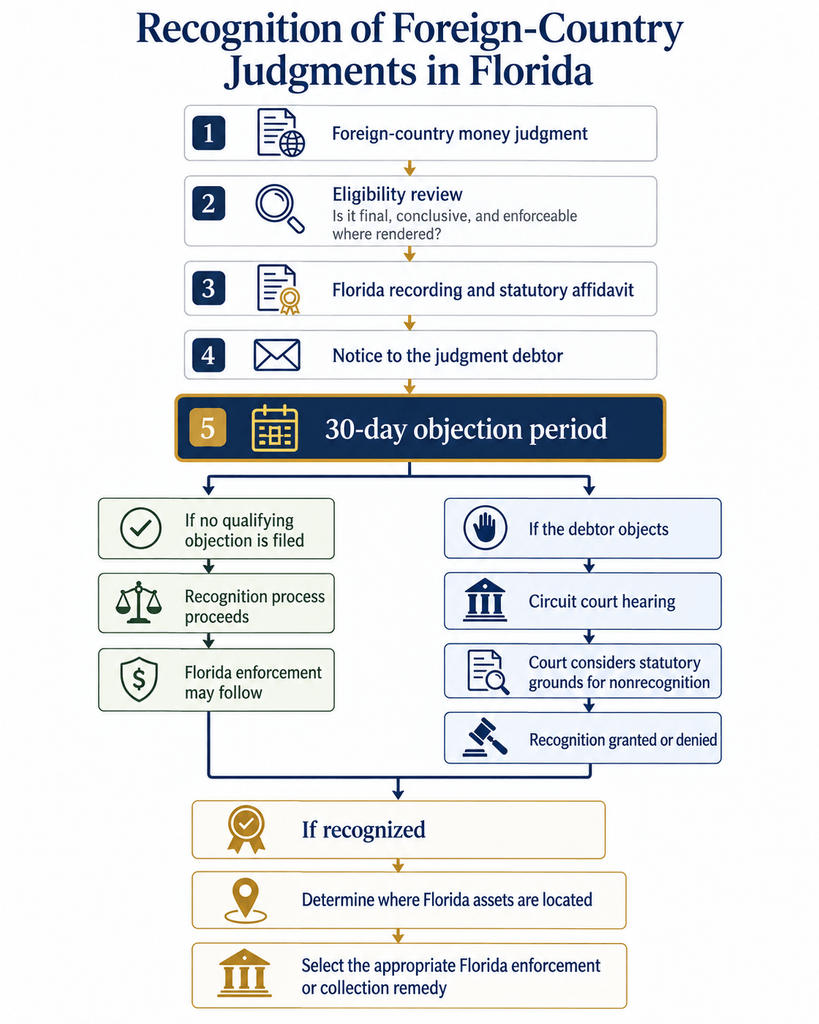
Florida’s foreign-country judgment recognition process moves from eligibility review and recording through notice, the 30-day objection period, recognition, and Florida enforcement.
What Happens During the Florida Recognition Process?
Step 1: Review the Judgment and Its Origin
The analysis begins with the country where the judgment was entered, the type of relief awarded, whether it is final and enforceable there, and whether an appeal or other proceeding remains pending.
This is also where the matter is classified correctly. A Canadian court judgment, for example, is not processed under the same Florida statute as a New York state judgment simply because both originated outside Florida.
Step 2: Prepare and Record the Florida Filing
For a qualifying out-of-country money judgment, the judgment and statutory affidavit are recorded where enforcement is sought. The specific filing strategy should reflect where the debtor or relevant Florida assets are located.
The statutory notice process then begins.
Step 3: Resolve Any Objection to Recognition
The debtor has 30 days after service of notice to object on grounds recognized by the Act. If an objection is filed, the circuit court can conduct a hearing and determine whether recognition should be granted or denied.
This is where issues such as jurisdiction, due process, notice, or fraud may become decisive.
Step 4: Enforce the Recognized Judgment
Once the Florida recognition requirements have been satisfied, attention shifts from whether Florida will recognize the judgment to how it can be enforced against the debtor or relevant Florida assets.
The next question becomes practical: Where are the debtor’s assets, and which Florida enforcement tools apply to them?
Why Clients Bring Foreign-Country Judgment Matters to Boyer Law Firm
Board Certification in International LawFrancis M. Boyer is Board Certified in International Law by The Florida Bar and has held the certification since 2014. His Florida Bar profile also lists him on the International Law Certification Committee. The Florida Bar currently lists 39 attorneys statewide with this certification, reflecting substantial international law experience, continuing legal education, peer review, examination, and rigorous qualification standards. | Experience With Judgments From Multiple JurisdictionsBoyer Law Firm handles cross-border matters involving clients and jurisdictions throughout Europe, Canada, the Americas, Africa, the Middle East, and other international markets. That cross-border experience is relevant because a Florida recognition case starts with a judgment and proceeding that took place under another legal system. |
Florida Litigation and International-Law Experience in the Same MatterRecognition of a foreign-country judgment sits at the intersection of international law and Florida civil procedure. The Florida filing cannot be evaluated in isolation from what occurred before the foreign court. Boyer Law Firm’s practice includes international litigation and cross-border matters, allowing the recognition question to be considered together with the Florida enforcement objective. | Representation Focused on the Judgment You Actually HoldA foreign-country money judgment should not be treated as interchangeable with a sister-state judgment, arbitral award, or family court order. The first task is identifying the correct legal framework. From there, the strategy can focus on recognition, any expected challenge, and the Florida assets or enforcement objective that made the proceeding necessary in the first place. |
What Should You Have Ready for an Initial Review?
You do not need to know the Florida procedure before contacting counsel. You should, however, be prepared to identify the basic facts that determine which procedure applies.
Useful information includes:
- The country and court that issued the judgment
- A copy of the judgment
- The date the judgment was entered
- Whether the judgment awards money
- The unpaid amount
- Whether the judgment is final and enforceable in the originating country
- Whether an appeal has been filed or remains available
- Information about how the debtor participated in the foreign case
- The debtor’s current location
- Florida bank accounts, real estate, business interests or other known assets
- Any prior attempt to recognize or collect the judgment in the United States
- Any objection already raised by the debtor
Those facts allow the initial review to focus on whether Florida recognition is available and what the realistic enforcement objective would be.
Florida Offices for Foreign Judgment Matters
Boyer Law Firm has Florida offices in Jacksonville, the Orlando area, Miami, Tampa, and Boca Raton. The correct filing location in a judgment-recognition matter depends on the facts of the case and where enforcement is sought, rather than simply which Boyer Law Firm office is closest to you.
International clients do not necessarily need to be physically located in Florida for a Florida enforcement issue to arise. The relevant connection may instead be the debtor, company, property, account, or other asset located in the state.
Boyer Law Firm May Be Able to Review Your Florida Enforcement Matter If:
You may have a potential Florida recognition and enforcement matter if:
- You already have a judgment issued by a court outside the United States.
- The judgment awards a sum of money.
- The debtor, business, real estate, bank account, or other assets have a Florida connection.
- You need recognition in Florida before collection can begin.
- The debtor has objected, or you expect an objection involving jurisdiction, notice, fraud, due process, or another ground under §55.605.
- A pending foreign appeal or stay may affect when enforcement can proceed.
If those circumstances match your situation, the next step is to determine whether the judgment qualifies for recognition, whether an objection is likely, and what Florida enforcement objective makes the proceeding worthwhile.
Speak With Boyer Law Firm About a Foreign-Country Judgment in Florida
If you already have a foreign-country money judgment and the debtor or assets are connected to Florida, the next issue is whether Florida law permits recognition and what will be required to enforce it.
Boyer Law Firm can review where the judgment was entered, its current status, potential grounds for objection, and the Florida connection that makes enforcement necessary. That review can determine whether domestication of a foreign judgment in Florida is the correct route and what should happen before collection efforts begin.
FAQs About Foreign-Country Judgments in Florida
What is domestication of a foreign judgment in Florida?
For a qualifying foreign-country money judgment, “domestication” commonly refers to obtaining recognition so the judgment can be enforced in Florida. Florida’s Uniform Out-of-Country Foreign Money-Judgment Recognition Act governs qualifying money judgments issued by foreign states. Once the applicable recognition requirements have been satisfied, Florida enforcement measures can become available.
Does Florida automatically recognize a judgment from another country?
No. A foreign-country judgment does not become enforceable against Florida assets simply because it was entered abroad. The judgment must fall within Florida’s recognition statute and satisfy its requirements. It generally must be final, conclusive, and enforceable where rendered, and the debtor may raise grounds for nonrecognition identified by Florida law.
How long does a debtor have to object to a foreign-country judgment in Florida?
Under §55.604, the judgment debtor has 30 days after service of the notice of recording to file an objection and specify the grounds for nonrecognition or nonenforceability. If an objection is filed, the circuit court may conduct a hearing and determine whether the judgment should be recognized.
Can a foreign-country judgment be recognized in Florida if it is being appealed?
Potentially. Section 55.603 applies to qualifying judgments even when an appeal is pending or still available. A separate provision allows a Florida court to stay the recognition proceeding when the defendant satisfies the requirements of §55.607, including showing that an appeal is pending or intended and that a stay has been obtained from the foreign court.
Is a foreign-country judgment handled the same way as a judgment from another U.S. state?
No. Florida uses different statutory regimes. Sections 55.501–55.509 address qualifying judgments from other U.S. jurisdictions under the Florida Enforcement of Foreign Judgments Act. Foreign-country money judgments are addressed separately under §§55.601–55.607. Correctly identifying which framework applies is one of the first steps before a Florida filing is prepared.

About Francis M. Boyer
Francis M. Boyer, B.C.S., is the principal attorney of Boyer Law Firm, P.L. He is a member in good standing of The Florida Bar and has been Board Certified in International Law since 2014. The Florida Bar currently lists him as a member of its International Law Certification Committee.
LET’S TALK
Ready to Discuss Your Legal Matter?
Whether you need international divorce representation, estate planning guidance, litigation support, or strategic legal counsel, our firm is here to help you understand your options and next steps.
Testimonials
Why Clients Call Boyer Law Firm First
Clients call Boyer Law Firm when international law, family issues, or civil disputes need strategic counsel, responsive communication, and a clear plan forward.
I was referred to Boyer Law Firm for my business lawsuit. I worked with Attorney Francis Boyer who has ton of experience. He explain complex subjects of law in simple terms. He gets things done professionally.
Business Owner
From France, I obtained complete satisfaction from the services of Boyer Law Firm. The language and cultural obstacles were quickly removed.
Client
Francis Boyer and his team have demonstrated remarkable responsiveness and professionalism for years. I feel totally secure when I benefit from the firm's assistance with a legal problem.
Client
I had a great experience with this law firm in my international custody case. They were very professional and very responsive to my concerns. The attorneys are smart and know their stuff. I felt like they genuinely cared vs just taking my money like many other law firms I contacted. I'm very happy with the result. I couldn't be more grateful.
Client